
INTELBRIEF
September 28, 2026


Baghdad Asserts its Sovereignty as U.S. Troops Depart
Bottom Line up Front
- The September 30 completion of a U.S. military withdrawal from Iraq will reorient the U.S.-Iraq relationship from security cooperation to a broader range of regional geopolitical security challenges.
- The U.S. pullback leaves Iraq’s Kurdish north vulnerable to attacks and pressure from the Iraqi Federal Government, Türkiye, Iran, and other regional actors.
- The key test of Iraq’s emergence as a sovereign state, aligned with the Arab world, and not Iran, will come from the success or failure of the government program to disarm Iran-aligned Shia militias.
- Iraq’s Prime Minister Ali al-Zaidi has announced a delay in the implementation of the militia disarmament plan to forestall domestic unrest from Iraqi Shias who view the militias as their protectors, but even the new deadline is likely to slip.
On September 30, U.S. troops, along with forces from a smattering of coalition partners, will formally end their support mission for the Iraqi government, in accordance with a September 2024 U.S.-Iraq agreement. The withdrawal provides the Baghdad government with an opportunity to firmly establish its sovereignty and retake its place in the region after more than two decades of U.S. tutelage. After overthrowing Saddam Hussein’s regime and then putting down raging insurgencies, U.S. forces were withdrawn in 2009 but redeployed in 2011 to help Baghdad defeat an Islamic State (IS) offensive that nearly brought down the government. Both Washington and Baghdad assess that IS has been sufficiently weakened and Iraqi security forces strengthened enough to permit U.S. forces to return home. The withdrawal of U.S. forces will redefine the Iraqi federal government’s relationship with Washington, whose military presence in the country — even if a fraction of the 100,000-person force that occupied Iraq during 2003-2004 — gave U.S. officials preponderant influence over Iraqi decision-making.
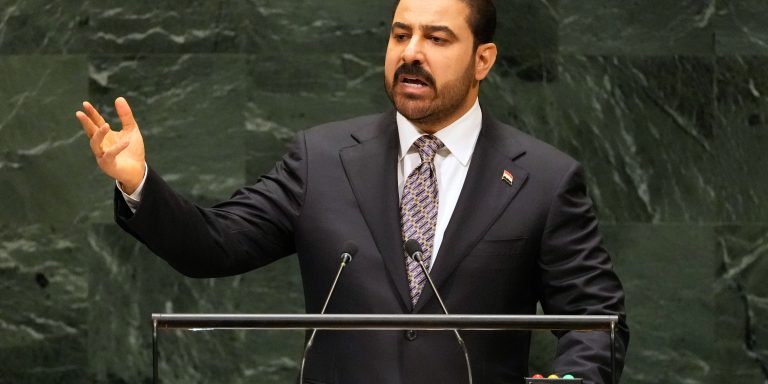
As the U.S. departure deadline approached and Washington’s tutelage over Iraq faded, Iraqi leaders have elevated their presence on the world stage, and their relations with the U.S. have broadened beyond security issues. Ali al-Zaidi, an entrepreneur and political neophyte, was selected Prime Minister in April for his purported ability to attract global investment and advance both political stability and prosperity. Zaidi visited Washington, D.C. in July to engage with the Trump team on a broad range of issues. Last week, in his speech to the 81st UN General Assembly, Zaidi said Iraq aims to become “an effective economic power in the region” and a “global hub for energy production.” He cited plans to raise crude output, develop gas fields and expand refining and petrochemicals. On Tuesday, on the sidelines of UNGA, Zaidi joined Arab and other regional leaders for a meeting with President Trump to discuss bringing the war in Iran to a conclusion.
Iraq’s regional profile has risen as the gradual U.S. military withdrawal proceeded. Late last year, the 2,500 U.S. forces in the country relocated to Kurdish-controlled northern Iraq from federal Iraqi territory. On Thursday, the U.S. handed over a diplomatic and logistics hub at Baghdad International Airport to the government. Iraqi official sources told AFP earlier this month that American troops had already evacuated the site ahead of the formal transfer. As the security mission fully transitions to Iraqi control, Washington will leave in place a small, residual force that will continue to help Baghdad combat IS remnants and other threats. However, U.S. officials have not publicly clarified the expected troop levels that will remain in Iraq, or their rules of engagement.
Also expiring on September 30 is a 2022 memorandum of understanding (MOU) between the U.S. and the constitutionally authorized Kurdistan Regional Government (KRG), which runs the three Kurdish-inhabited provinces of northern Iraq. Under the MOU, Washington had already shifted responsibility for paying the salaries of the separate Kurdish security forces (Peshmerga) to the Iraqi Federal Government. The MOU also mandates merging — under the control of a single ministry — the Peshmerga'sparty-aligned units, primarily those of the two main Kurdish political factions, the Kurdistan Democratic Party (KDP) and the Patriotic Union of Kurdistan (PUK). Downplaying their rivalry, Kurdish leaders last week formally inaugurated the merger ahead of the September 30 deadline. At the gathering, KRG President Nechirvan Barzani, a senior KDP figure, said the unified Peshmerga force would be "part of the Iraqi national defense system."
Experts expect Iraq’s Kurds to struggle to compensate for the U.S. military departure. External backing, particularly from the U.S., has always underpinned the KRG’s semi-autonomy and security. Since the Iran war began February 28, Erbil has counted on the U.S.-led coalition's air defenses, which intercepted roughly 95 percent of the drones and missiles fired by Iran and its Iraqi militia allies at targets inside KRG territory, including U.S. facilities. The departure of the U.S.-led coalition leaves the KRG bereft of an independent capability to counter such attacks, and more dependent for its security on what have been unreliable -- and sometimes openly hostile -- governing partners in the Iraqi Federal Government.
On the other hand, the U.S. withdrawal sets the stage for an easing of Turkish military pressure on the KRG and the Iraqi Federal Government. Over decades, Türkiye’s military has conducted “hot pursuit” of outlawed anti-Turkish Kurdish groups, primarily the Kurdistan Workers’ Party (PKK), that enjoyed safe haven from fellow Kurds in northern Iraq. Last week, as the U.S. was completing its departure, Türkiye and Iraq agreed to a gradual transfer of Ankara’s military base in the northern Iraqi town of Bashiqa to Baghdad’s control. The announcement followed a meeting between Zaidi and Türkiye’s President Recep Tayyip Erdogan on the sidelines of the UNGA sessions. According to Zaidi’s office: “Within this framework, the [two leaders] reached an agreement on fully establishing state authority in Sinjar and ending the presence of outlawed foreign armed elements.” The reference to Sinjar applied to the presence of PKK-linked fighters in the mountainous Sinjar region of northern Iraq. Türkiye first established the base in Bashiqa, northeast of Mosul, in 2015 by agreement with the KRG under which 600 Turkish soldiers trained Iraqi Peshmerga units fighting the Islamic State organization. The Turkish deployment nonetheless drew criticism from Baghdad, which viewed Ankara’s presence as a violation of Iraqi sovereignty.
Zaidi and his team acknowledge that, now that U.S. troops have left, Iraq’s geostrategic trajectory and affirmation of full government sovereignty will be determined by the outcome of the government’s power struggle against Iran-aligned militias. Several of the Shia militia groups remain active in the country, acting independently of the Iraqi command structure and against the U.S. and its regional allies, particularly Kuwait and Saudi Arabia. Their political wings, which subscribe to Iran’s “resistance ideology,” have led public demonstrations denouncing the U.S.-led war on Iran and supporting Iran’s counter-moves. Last week, one group, the Badr Organization, led protests against the U.S. effort to block Iranian airlines from operating outside Iran. The U.S. security mission in Iraq did not formally include defeating or disarming the militias, although U.S. forces sometimes retaliated for their Iran-inspired attacks on the U.S. Embassy, consulates, and U.S.-manned bases in the country. Those attacks long predated the U.S.-Israeli war against Iran, as the militia groups have long sought to expel U.S. forces from the region, but the attacks have expanded since the war began.
In accordance with pledges to Washington, the September 30 deadline for the departure of the U.S. military contingent from Iraq was to coincide with the date-certain for the Iran-aligned militias to disarm. The government argues that the U.S. withdrawal removes the militias’ justification for remaining armed. Yet Baghdad’s demand for demobilization has always been fraught with tensions and the potential for violent domestic unrest. In addition to conveying Iran’s ideology, the militias have strong social roots among Iraqi Shias, serving as protectors against the government and outside forces such as the U.S. and its mostly Sunni Arab allies. The more heavily armed, pro-Iranian, and capable groups, such as Kata’ib Hezbollah (KH), Kata'ib Sayyid Al-Shuhada, and Harakat Hezbollah al-Nujaba, have steadfastly rejected disarming by the announced September 30 deadline, while not rejecting eventual disarmament outright. Some militias, including Asa’ib Ahl Haq and fighters loyal to firebrand Shia cleric Moqtada Al Sadr, have since early 2026 responded to the government’s call to fold into the national armed forces.
In his UNGA speech, Zaidi reinforced his commitment to demobilize the Iran-aligned militias, saying the state must be “the ultimate decision maker in matters of peace and war,” with weapons held only by constitutional institutions. He added that work toward this goal is “moving on track.” However, seeking to balance the interests of Washington and his mostly Shia political base, Zaidi admitted last week that the militia demobilization process would be delayed, telling the New York Times that the new deadline for completing it would be June 30, 2027. Iraqi media reported Tuesday that the demobilization effort would begin with a 90-day halt to all militia attacks, starting September 30. Baghdad has also altered the goals of the program, insisting not on full disarmament but instead on the gradual integration of individual militia fighters into official security forces. Militia fighters will hand over their weapons and individually — not on a unit-by-unit basis — join the Popular Mobilization Units (PMUs), which are overseen by Iraqi military commanders and governing institutions. The government has left unclear what it sees as the eventual fate of the political wings of the various militia groups, some of whose leaders are elected members of the Iraqi Council of Representatives (Iraq’s parliament). Many regional observers say they will not be surprised if militia resistance causes the disarmament effort to fail outright, leaving Iran’s Iraqi allies in place and able to project power within and outside Iraq.