
INTELBRIEF
September 17, 2026


Iran War Solution Nowhere in Sight as U.S. and Iran Remain Entrenched
Bottom Line Up Front
- Iran and the U.S., both under significant economic pressure, have expressed a willingness to de-escalate, but neither side has yet showed signs of softening their core demands, respectively.
- A ground advance by the Iran-backed Houthis in Yemen and the elevation of world energy prices are eroding the leverage U.S. leaders need to bring the war to a conclusion on terms acceptable to Washington.
- Houthi attacks on Saudi Arabia caused the cancellation of an Iran-Gulf state meeting, planned for Monday, that regional and global leaders expected might set conditions for a settlement.
- Continuing U.S.-Iran exchanges, such as a U.S. strike on Islamic Revolutionary Guard Corps (IRGC) fast-attack boats Monday, might at any time escalate into major combat.
After frequent expressions of disinterest in new negotiations with Tehran, U.S. President Donald Trump on Monday said he is once again open to talks with Iran. Writing on his Truth Social media account, Trump stated Monday: “The failing Nation of Iran wants to make a deal, quickly and badly. I will determine whether or not the U.S.A. will choose to engage – The concept of which we are open to.” Trump’s post followed claims on Sunday by Energy Secretary Chris Wright, speaking to Bloomberg News, that a U.S. refocus on the issue at the core of the U.S.-Iran conflict — Iran’s nuclear program — might bear fruit.
Wright restated U.S. proposals for a nuclear agreement under which the U.S. supplies Iran with nuclear fuel if Tehran eliminates its uranium enrichment program. He told the outlet: “We prefer to negotiate. Or, they can continue to have a covert, buried, lied-about, hidden nuclear weapons program and face the U.S. military, which will ensure they do not develop nuclear weapons…We can supply fuel from outside the country. They could join the community of nations again and bring peace and prosperity to their people.” Yet, neither Trump nor anyone else in the administration has articulated a specific softening of U.S. demands for a settlement, which include the unfettered reopening of the Strait of Hormuz, devoid of any Iranian or regional imposition of fees or tolls on commercial shipping.
The Trump team’s perception that it can secure a settlement without making further meaningful concessions stems from favorable shifts toward the U.S. during the summer. By all accounts, and despite experts’ disagreements over specifics, U.S. Navy operations are guiding increasing volumes of energy exports through the Strait of Hormuz. A U.S. official told journalists last week that the U.S. military and the Arab Gulf countries have begun conducting daytime transits of tankers through the Strait — and not only nighttime as was the case in recent months — suggesting greater confidence that they can avoid or thwart Iranian attacks. U.S. forces have also expanded the mine-cleared parts of the Strait’s middle shipping lane. And U.S. officials assess Iran’s economy is buckling under the weight of a U.S. naval blockade and crippling economic sanctions. The value of Iran’s currency has declined dramatically in recent weeks, and Iran’s civilian leadership is openly admitting to sharp economic deterioration and forecasting political unrest if conditions do not improve.
To maintain U.S. leverage, U.S. officials have sought to demonstrate that they are still willing to use force, even as they accept that there is no military solution to the conflict. On Monday, the U.S. military destroyed two Islamic Revolutionary Guard Corps – Navy (IRGC-N) small fast-attack craft as they tried to steal a U.S. Navy drone boat patrolling the Strait of Hormuz. U.S. Central Command (CENTCOM) spokesperson Captain Tim Hawkins confirmed the attempted seizure, saying, “Iranian small boats recently attempted to take possession of a U.S. unmanned surface vessel, but they were unsuccessful after CENTCOM forcefully responded…The surface drone remains under U.S. operational control.”
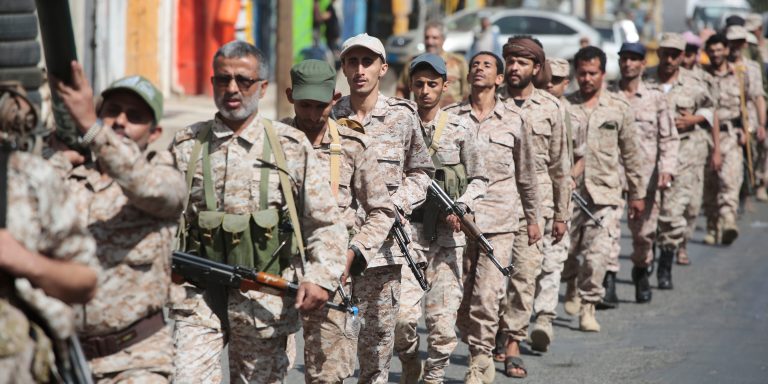
Iran’s regime shows no signs of flexibility, despite clear signs of economic distress in Iran. The IRGC has continued to attack ships transiting the Strait, restricting exports through the waterway while also increasing the potential for additional, and escalating, exchanges with U.S. forces. Iran’s regional allies, despite setbacks, have shown that they remain capable of shifting the balance of power toward Tehran. A ground advance by the Iran-backed Houthi movement in Yemen last week has positioned the group to close the Bab el-Mandeb Strait with direct weapons fire. The Houthis, as well as Iran-aligned militias in Iraq, have attacked key Saudi energy infrastructure targets, including damaging several pumping stations that operate the East-West pipeline that carries Saudi oil to the Red Sea, avoiding the Strait of Hormuz. The damage has caused world oil prices to spike over the past ten days, including pushing diesel fuel prices to all-time highs. Reluctant to expand U.S. operations in the region — and following reported U.S.-Houthi talks in Muscat last week — President Trump has opted not to intervene directly to help Saudi Arabia and its Yemeni allies counter the Houthi gains. Collectively, the recent developments have convinced Iranian hardliners that their strategy will ultimately succeed in compelling Trump to end the war on terms favorable to Tehran.
Emboldened by the favorable battlefield trends, on Monday, IRGC Major General Mohsen Rezaei, Secretary of the Supreme National Security Council, the country’s highest decision-making body, reiterated that Tehran’s stance remains rigid. He told state media: “The stakes around oil and the straits have changed. Damage control won't stop what's coming. No talks until Iran’s conditions are met. Period!” Specifically, Tehran is demanding that Washington meet its obligations under the June U.S.-Iran Memorandum of Understanding (MOU) before resuming the diplomatic process. The preconditions Tehran has articulated include lifting the naval blockade, unfreezing Iranian frozen assets, removing its military assets from “proximity” to Iran, and forcing Israel to end its military assaults on Lebanese Hezbollah and Hamas.
Rezaei’s firm statement contrasts with those of more moderate civilian leaders, particularly the elected President Masoud Pezeshkian, who has warned that U.S. economic pressure could spark another popular uprising. He told India Today Saturday: “We are ready for dialogue,” adding that any nuclear negotiations should take place within the framework of the Nuclear Non-Proliferation Treaty and international law. Pezeshkian repeated earlier suggestions that both sides return to the June MOU, which collapsed under the weight of tit-for-tat exchanges and Iranian attacks on shipping. He stated: “I don’t know what was wrong with what we wrote in Pakistan [the MOU, also known as the Islamabad Agreement] that the United States now wants us to talk again from scratch…What was illogical there? What did we say that was outside the logical, legal, and scientific frameworks recognized in the world?” However, the inflexibility of Iran’s positions affirms that hardliners, including Rezaei, retain the political upper hand in Tehran’s decision-making, at least for now.
Even as U.S. and Iranian leaders reject concessions, global diplomats have pointed to talks among the regional stakeholders as a potential off-ramp. Regional mediators have looked to talks between Iran and Oman on management of the Strait of Hormuz as an avenue for the U.S. and Iran to return to the MOU and to bilateral talks. In a rare diplomatic initiative, Iranian officials agreed to attend a meeting on Monday with the Arab Gulf monarchies in Salalah, Oman, to review an Iran-Oman agreement on shipping routes through the Strait of Hormuz. Regional leaders were optimistic the Gulf nations might use the meeting to assert a collective response to a war they had no part in starting. Global leaders were particularly encouraged by reports that Tehran and Muscat had agreed to a regime of voluntary contributions by shipping companies using the Strait to fund environmental cleanup and other costs. The joint Iran-Oman plan was to be registered with the United Kingdom Maritime Trade Operations Center (UKMTO), suggesting that Iran had agreed that the Strait arrangements needed to comply with international law.
However, U.S. doubts and regional developments scuttled the diplomatic opportunity. Iran’s Foreign Minister Abbas Araghchi told the London-based, pan-Arab news outlet Al-Arabi Al-Jadeed last week that, despite any agreement with Oman, Iran would not reopen the Strait until the United States satisfies Tehran’s demands. Asked about the Salalah meeting, President Trump dismissed the prospects of it producing a war-ending solution. The Gulf states’ distrust of Iranian intentions — coupled with the absence of U.S. attendance at the meeting — contributed to its collapse. Bahraini leaders said they would boycott the meeting because Bahrain has not restored diplomatic relations with Tehran, having broken ties in 2016.
Saudi Arabia, under severe challenge from the Houthi offensive that by Friday had seized all the coastal territory down to the Bab el-Mandeb Strait, balked at meeting with Iranian leaders while their Yemeni allies were attacking the Kingdom. Iranian Foreign Ministry Spokesman Esmail Baqaei confirmed reports that Riyadh had asked the meeting to be postponed, telling state media: “The report that Saudi Arabia requested that the meeting not be held for now is correct.” Oman’s foreign minister, Sayyid Badr Albusaidi, posted Sunday that the regional meeting had been postponed “in the interests of consensus.” Although Iranian officials say that the understanding with Oman on Strait management can still be implemented without Gulf state endorsement, the collapse of the Salalah meeting leaves regional mediators, as well as U.S. and Iranian officials, without any obvious roadmap for defusing the U.S.-Iran conflict. In the absence of a clear off-ramp, the most likely pathway ahead is further escalation.